

Game I bought with the intent of instantly playing only to end up on the backburner for a month. Sound familiar to anyone? In any case, I needed a breather after a massive game that was Odyssey so here we are. I am tempted to buy the remaining two Fuga games, but I’ve heard very mixed takes on them. Anyone else played and wants to share thoughts?
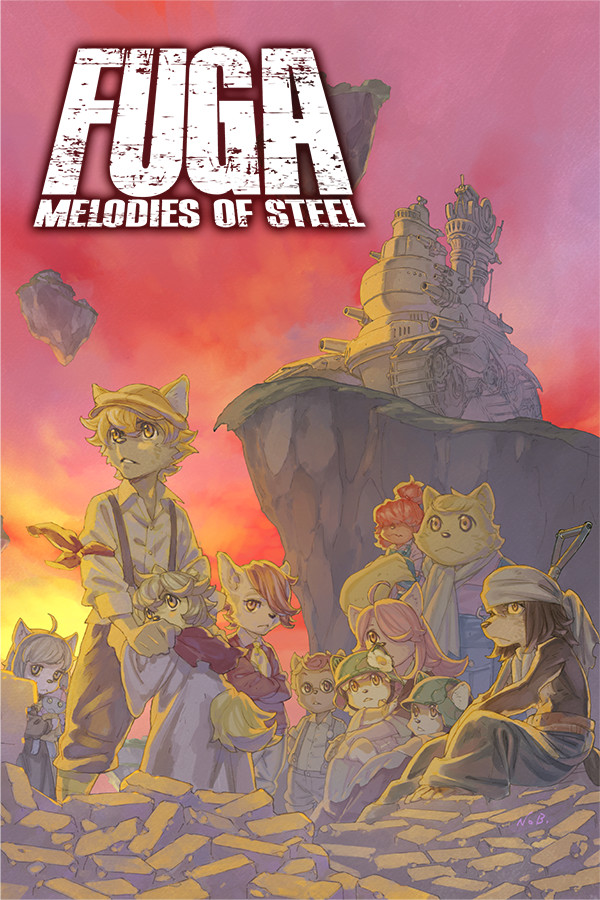
Fuga: Melodies of Steel
( PC – JRPG – 2021 ) + STEAM REVIEW
Failing to connect the dots between Fuga: Melodies of Steel and CyberConnect2’s developer opus, I overlooked how it ties to their previous works. This especially struck in the finale when the twist ending had me going “wait, I know those guys from that Nintendo DS game”. So let’s see how this turned out.
Free Lands of Gasco, in all their floating glory, are embroiled in a war against the Berman Empire. As its Felineko residents are resisting the lighting-invasion inflicted upon them by Caninu aggressors, a village of Petit Mona pays the price. Children are made to run away as their parents are captured… only to come across a cave where a stupendous tank seems to have been hidden. Upon entering it they’re greeted by a mysterious voice speaking from the radio. They’ve found Taranis, an ancient relic that just might help the kids save their parents and turn the tide of this war. Unleashing its terrifying weapon dubbed the Soul Cannon, however, requires a sacrifice. Will the children make it?
Thing with Fuga’s story is it’s not BAD, just weak. This is a JRPG, meaning the narrative is contractually obligated to go crazy towards the finale and involve some manner of ancient entity party has to fight to save the day, but until that point this really is all about a group of children overcoming obstacles in the hope of locating their parents. These obstacles come in the form of various Berman generals you’ll fight as mini-bosses along the way in predictable fashion. There is certain flair to this dark story as fantasy re-telling of WW2 with stand-ins for France and Germany where everyone is named after some dessert or another, though. Juxtaposition is strong in this one.
As far as characters go we have an ensemble cast where, realistically, no one gets the spotlight beyond their recruitment chapter. Except, I’d argue the very last character whose fate you get to decide as he’s the only one who is more than just a one-trait archetype. I don’t really intend this as a negative against the remaining eleven characters since this is the kind of anime setup we’re working with. You know the deal. “I am the oldest so the burden falls on me” balanced Malt, wannabe-inventor Socks, resident chubbo Boron which is his entire personality, etc. You’re dealing with children from 4 to 12 years of age, and it definitely comes across which is appropriate, I suppose. Antagonists are largely handed the same treatment as roadblocks in your way, some more or less villainous. I actually had hopes for their leader, but he ended up being the most predictable with how things turned out. Like I said, it comes with the territory.
What is Fuga: Melodies of Steel actually as a game? Well, it’s a JRPG on rails… or rather, treads. Since you drive a tank as your headquarters. Anyway, there are three distinct phases to the game: driving Taranis through zones representing each chapter where you get to choose from branching routes as form of bite-sized difficulty selection, turn-based combat itself which I’ll expand upon later, and lastly the downtime periods when you get to walk about in Taranis to do non-battle related activities. As you motor along linear levels icons on the top of the screen tell you what’s coming up so you can plan accordingly. Nothing like having your HP/SP replenished by a cache of goods or choosing whether you want to go after the elite enemy of your own volition. Very rarely this is broken up by game letting you explore Ruins you come across, but this exceedingly basic sidescrolling dungeon crawler doesn’t really engage much with those five minute runs. Decent way to get some crafting materials, though. I was also surprised to see brief access to barter shops at the start of every chapter as your crew comes across small villages where everyone is cheering you kids on.
Prior to getting into how combat works it is important to understand everything that goes into its composition.

Forks in the road are how you choose the difficulty of the upcoming section, as well as the quality of spoils.

Sections when you get to explore Taranis during downtime serve as your crafting, upgrading and socializing time.

Based on three damage types and delaying your enemies, the combat is less complicated than it might seem at first.

Character rapport builds Affinity granting bonuses in combat. Also some funny interactions.

Going into Ruin dives for crafting ingredients is the only welcome diversion you get, but it is a worthwhile one.
In this case, I’m talking upgrades you engineer to Taranis with enough materials and willingness to spend some of those precious 20APs you get during every Intermission. There’s a percentage chance involved, but I never saw an upgrade fail no matter the child doing it. This, as well as facility upgrades themselves, is what you’re gathering and saving materials for since those three weapons + armor and reactor are your lifeline in combat scenarios. Other facilities? Kitchen is your go-to since it imparts tangible buffs to all the characters in combat and those only get better as you upgrade it, probably followed by the Farm since it lets you gather what you need to actually cook. Usefulness of Dormitory where wounded character can recuperate will depend on how well you play, but like with all facilities on Taranis sometimes the kids just want to use them to increase their Hero Mode meter. What I’m trying to say is you’re constantly juggling upgrading, satiating the kid’s needs and building up relationships between them. Everything costs a certain amount AP so you’ll rarely be able to do everything at every Intermission. Pairing children with high relationship rank will not only unlock their Link attack, which is a special move with its own bar hitting all enemies, but also give them other combat benefits. That’s on top of letting you see little story vignettes as their relationship progress from rank 1 to 10. It’s worth to have most of them unlocked simply so you don’t lock yourself out of Link attacks and dedicated yourself to maxing out only some.
Now imagine all of the above feeding into combat and, well, it’s still a fairly straightforward system. You field six characters grouped into three pairs, hence the importance of relationships for synergies, but Taranis represents your HP and SP. Which doesn’t mean characters can’t become afraid, depressed or wounded based on special attacks inflicted upon the party. At its core Fuga is turn-based with a scaling timeline indicating whose turn is up. Things like attack delays and nature of attacks affects this. Machine Gun, Grenade Launcher and Cannon are each their own category from lightest to heaviest with speed to match, but characters also possess skills they acquire by leveling up. Even characters in the same weapon category share only some of the skills, though. Hanna and Jin are both medium category, but one is a dedicated healer while the other is an absolute killer when he enters his Hero Mode. Add to this every character has a passive bonus added to whoever they’re paired with and it’s a lot of elements being set up in the background without excessive front loading. Biggest thing you have to worry about with enemies is managing their armor, reduced with skills or one item, and delaying them by attacking with appropriate weapons. Since you can rotate characters in and out of the front line this becomes a matter of foresight and quick responses. I wish the game was as bit more challenging since once you figure out how to counter enemy types the danger is gone, but that’s what NG+ is likely for. I died once by severely overestimating one boss’ ability to wound your entire line in one fell swoop.
It’s interesting I’ve barely touched upon Fuga’s defining aspect – Soul Cannon. Whenever your HP goes critical during combat, likely during boss battles, your voice from the radio will start bemoaning how there’s only one hope and you must sacrifice a child to fire the Soul Cannon for instant victory. Lady, stop your yapping. I know what I’m doing. Needless to say, I did not use this special attack and my entire cast survived. I think the game forcing you to use it during the tutorial traumatized me for good.
Going with hand drawn 2D, Fuga looks absolutely gorgeous. This is especially evident when you unlock more and more artwork drawn by different people, and credited for it. Clear sign of what a labor of love this must have been for the art team is just how much of it is in the game. Down to an entirely optional issues of a comic you can find and read to follow Captain Sucre’s adventures. This did not need to exist, and yet it does. I would also say game occasionally punches above its weight as developers clearly did not have the budget they perhaps wanted. Grand scenes of epic action later on are sadly relegated to slideshows. It’s a good thing game’s soundtrack is there to seal the deal. I recognized some homages to earlier games without realizing it, but even on its own Fuga’s soundtrack is expansive with motifs aplenty. Voice acting, in Japanese and French of all languages, was also solved in budget-friendly manner where characters get sample lines and only the narrator is fully voiced.
Final Thoughts and Rating?
Trying to save their parents from the invading Berman Empire, Fuga: Melodies of Steel follows a group of children as they crew an ancient tank called Taranis, and who just might be the last hope for Gasco’s population against the Caninu invader set in the backdrop of fantasy World War 2 on a floating continent. An on-rails, turn-based JRPG with Intermissions between combat gives you the opportunity to upgrade the tank itself as well as build up relationships between children. Relationships which will end up being vital for combat performance as well as determining their fates in a grander story going beyond their little village. Amidst it all looms the constant temptation and threat of using the Soul Cannon and extinguishing a single child’s life for a guaranteed victory in any battle.
